
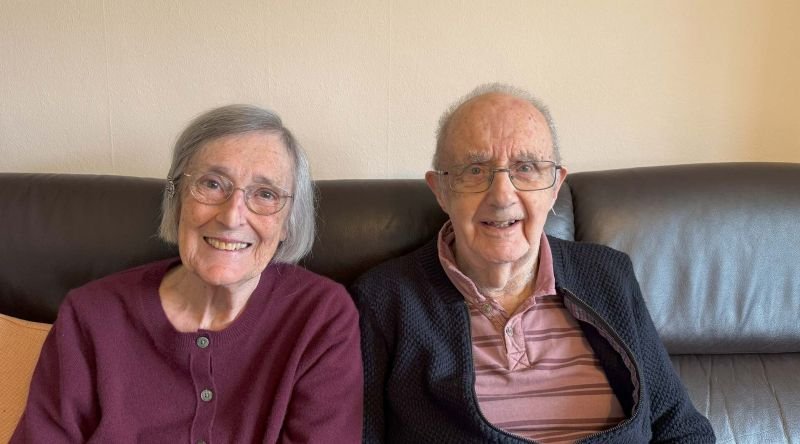


Trish lives in Guildford with her husband, Brian. She has heart and lung conditions, has had a stroke, and one of her vocal chords doesn’t work. Trish is being cared for by our Living Well team, who support patients to manage living everyday life with their illness, and attends sessions at our Beacon Centre. As her carer, Brian is also supported by the team.

“We felt fairly lost when we were referred,” said Trish. “They couldn’t find a reason for what was wrong with me. I left hospital in July 2023 only vaguely knowing what was the matter, and saw a consultant the following January. She sent me for various scans and tests, and I failed most of them.”
Trish’s consultant referred her to our care, and she was contacted by Louise, one of our Living Well nurses.
“I had a phone call from Phyllis Tuckwell, and I thought ‘Phyllis Tuckwell, but that’s a hospice’. But lovely Louise, she’s so sweet, she told us all about it, and we learnt that Phyllis Tuckwell isn’t just a hospice.”
Many people know about our In-Patient Unit, where we provide symptom management and end of life care, but they don’t always know about the support we provide to patients earlier in their illness. Our Living Well team offers individual and group sessions which provide patients with information, advice and guidance on how to manage their symptoms and live life as fully and independently as possible. The team runs two eight-week programmes, Living Well with Illness and the Creative programme. Each weekly session lasts for two hours and includes time for patients to talk with our nurses and therapists, and get to know the other patients there over tea and biscuits. The Living Well with Illness sessions cover topics such as Food and Nutrition, Remaining Active, and Improving your Sleep, while the Creative sessions focus on activities including Therapy through Nature, Cooking with Confidence, and Lotions and Potions. Patients benefit from engaging in the physical and sensory experience that these activities offer, and gain a sense of achievement that comes from creating something.
“I’ve done gardening, that was one of the first ones I did,” said Trish. “We did a pot of cyclamen; I put it outside and it’s had flowers on it all winter. We planted bulbs too and took cuttings from a succulent. We did cooking as well; I made stuffed green and red peppers, and we made a chocolate desert. It’s not just what you do, it’s the fact that you can then do it. You’re not restricted because you can’t breathe very well, or you’re coughing all the time, or your hands are shaky. There’s always somebody there to encourage you, and to help you with what you can’t do; they helped me when I didn’t have the energy to bash biscuits! I don’t think there is such a word as ‘can’t’ – not at Phyllis Tuckwell. If you aren’t able, somebody else will do it with you. It’s a joy to see people’s faces when they see something done for them. Everybody enjoys it, and everybody chats away, in fact I chat too much, but that’s just me. I think that’s it - people can be themselves. You learn from the other people there too, how they are managing or not managing, or what help they get. It's all sharing, and it makes a difference to know that you’re not the only one.”
At our Lotions and Potions session, patients learn how aromatherapy can help ease symptoms and promote a sense of tranquillity and wellbeing. Aromatherapy uses essential oils, concentrated plant extracts which each have their own unique qualities and can be used to ease a variety of symptoms. Patients are shown how to use these oils in creams and nasal inhalers, and can then choose the most suitable ones to ease their specific symptoms, and use them to make creams and inhalers which they can take them home with them.
“In the aromatherapy session, we were given geranium to smell. I made a cream, and I could choose what it was for. I have very dry skin on my legs, so I made one to help with that. We also made an inhaler stick; I chose to make one to help if I couldn’t sleep. We not only did it, but we learnt about it. We had two ladies who talked to us about it, and I had a list of the oils, like a recipe. It’s something for you to use your brain to think about, to stimulate you. Without Phyllis Tuckwell, I could have just stayed at home and stagnated. From stagnation to stimulation!”
“Sometimes one of the nurses at the session will tell you that sadly one of the patients has died, and you think ‘oh, that’s sad, but I’m sure they were cared for and loved by everybody looking after them’, and that’s what you know will be there for you when your time comes. I’m enjoying being better at the moment, but when I’ve not been well I’ve had phone calls from the nurses, and from the rehabilitation assistants, Molly and Susie. They ask how I am. They’ve got access to my records and they keep an eye on me. It’s very reassuring.”
For many of our patients, being able to express their feelings around their illness can really help their mental and emotional wellbeing. Our Artscape group, led by some of our volunteers, offers 10 weekly sessions where patients can use art to explore feelings around their illness that might be hard to put into words. Trish enjoyed these sessions and was delighted to be invited to a group mandala workshop run by our volunteer art therapist, Kara.
“It was one of those beautiful days that just spring out of the blue,” said Trish. “I’d already done Artscape and that got me going in the first place. It set me off to try new things, and I was absorbed. I started with watercolours, which I had used when I was at school. I wanted to go on, but I never did. I did flower arranging, knitting, sewing, embroidering, crocheting, but not drawing or painting. I’ve always been a creative person, so I had missed that. Phyllis Tuckwell has renewed my desire to paint. They spark something that you’ve got within you. I hadn’t done anything with acrylic though, and I knew I wanted to try it, so when we did the mandalas I chose an acrylic one and used the acrylic pens, instead of paint. I’ve got so much pleasure and satisfaction out of doing it all. My granddaughter saw the mandala I had made and suggested I make more for the family for Christmas presents. That was in September last year. So I did, I made eight. I wanted to put in some of what I’d experienced at the Living Well sessions. On one of them, I drew a marigold in the middle, some lavender, and blue mallow flowers around the outside - they were in some of the creams we made. I’m on the tenth one now!”
Trish and Brian have also attended our pamper days, which offer patients and carers complementary therapies such as massages or reflexology, and haircuts, manicures and pedicures. They can also enjoy some cuddles from the Pets as Therapy dogs that visit.
"We’ve been to two now,” said Trish. “Brian had his toenails cut and I had a back massage, oh, golly me, that was good, I felt really free afterwards. You could have a foot massage or a hand massage, and have your toenails painted. You meet lots of people too, and you remember them, you carry them in your thoughts. It all adds to pure enjoyment. You don’t always get enjoyment every day, sometimes you have to think hard to find a bit of enjoyment, but there’s enjoyment at those sessions. I’m looking forward to the next one. It’s the satisfaction that I get from it that I wouldn’t have got from anything else.”
Brian is still able to drive, so he can take Trish to the sessions, but at times he has been unwell and unable to. On those occasions, Trish has been taken to and from the sessions by one of our volunteer drivers.
“I know that if we are completely stuck, we can phone up,” she said. “Having that support is vital to me. I feel bad about asking because I know it’s not easy for them to arrange, but I’m so grateful that they can do it, and the volunteers are so lovely.”
As well as caring for Trish, the team also supports Brian. Our six-week carers’ programme offers weekly online sessions which provide the carers of our patients with useful advice and information, as well as an informal environment where they can meet other carers and share experiences with them. We also offer weekly carer support drop-in sessions, where our patient and family advisors give support on financial and practical matters, such as claiming benefits and applying for blue badges. We run monthly carers’ coffee sessions, where carers can meet others and find peer support and friendship, and fortnightly coffee afternoons for both patients and carers, where they can have a relaxing complementary therapy treatment and chat to our staff and volunteers.
“Brian did the online carers’ group, which was helpful,” said Trish. “That covered a lot of stuff we didn’t know.”
“It was very good,” agreed Brian. “They told me what I could do to help myself and to help Trish, and that was very useful. They tell you about all the things you can claim for too, all the benefits. A lot of people don’t know what’s out there. They checked to make sure we’d made our Wills and we had power of attorney, which is very important, for both money and health. Then we started coming to the coffee afternoons. They help because you’re talking to different people who are all looking after someone. It helps to talk; it gives me an outlet. We talk to each other about how we’ve cared for people, and what help is out there. It’s good to know you’re not the only one. I feel supported at the coffee afternoons, especially the carers’ ones.”
“When you’re diagnosed with a terminal illness, you lose something,” said Trish. “But at Phyllis Tuckwell, they bring out people’s abilities, people’s lost character. Those bits are reignited; they’re still there and they’re there to celebrate. Phyllis Tuckwell has changed my whole attitude. What’s happened to me has happened, but it’s not taken over; I can get past it.”

