
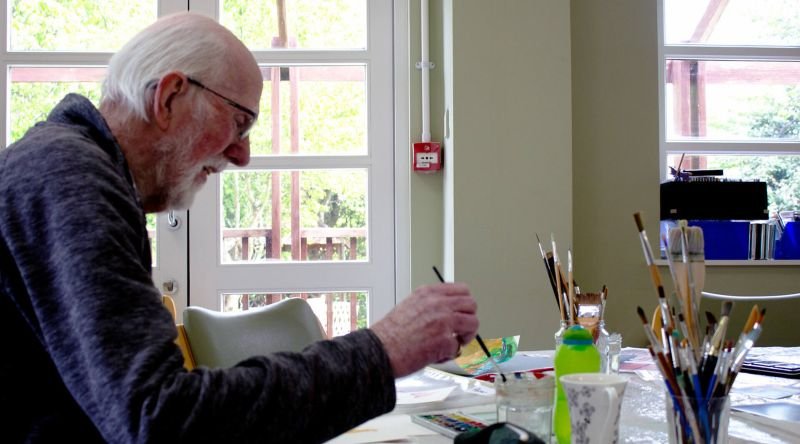


“Everybody here is so friendly. As soon as I walk through the door, it's ‘hello Peter’. It’s that nice feeling of arms wrapping around you; it’s lovely.”

Peter was referred to our care in April 2025, by his respiratory occupational therapist. He has attended several different group sessions run by our Living Well team, who support patients to cope with living everyday life with their illness.
“The first course I was invited to was on breathlessness. I have a lung problem called idiopathic pulmonary fibrosis, and I also have Crohn's disease. The course taught us techniques for how to breathe. It was very useful; there were lots of little tips and tricks that I could use.”

“After that, they invited me to the Living Well with Illness course. That was very good because you were able to talk to all sorts of different people about your condition and things that were going on, dietary issues and things like that. We also talked about ourselves and our hobbies. I said art was one of my hobbies, and they said, ‘well, perhaps the art therapy course would be good’.”
So that we can provide tailored, bespoke care for each of our patients, our teams get to know them as individuals. They find out about the things that are important to them and ask them about any difficulties they are facing because of their illness. When the team learnt that Peter was interested in art, and that his breathlessness was preventing him from going on the long walks that he used to love, they suggested that he might benefit from our art therapy sessions. These one-to-one sessions are run by Kara, our art therapy volunteer, and can help patients to express and work through feelings related to their illness, which might be hard to put into words.
“Kara was a great help. I used to be quite active, doing lots of walking, travelling abroad, things like that, but now I can't do any of those things, and that was getting to me. I was getting depressed, I suppose, thinking about all the things I couldn't do anymore. It was weighing me down. My wife and I used to go on long walks, five or six miles. We live in Elstead, and there are such nice walks around there. So I talked through those emotions with Kara. She said it was a form of grieving, because it's things that I'd lost, that I can't do anymore. She suggested I take a blank piece of paper, choose a medium, like water colour or something, and then just make some marks on the paper. You literally just splash some paint on, and then she'll stop you there and say, ‘right, what does it look like?’ And she’ll turn it around different ways and said, ‘what can you see in that?’ And you start talking about what it means to you. Nearly all my paintings involve a pathway to somewhere, because that's what I want to do, I want to walk down a pathway and go out into the countryside. Being able to talk to somebody like that helped a lot. It helped with my art as well, because I was getting to the point where my art was blocked. I'd stare at a blank piece of paper, not knowing what to paint. The sessions have unblocked my art process. I can now get a piece of paper and just rough something down, and start painting from there. I paint landscapes, buildings, trees. It’s about concentrating on the things that I can do and making the most of those, and mostly what I can do now is paint.”
Since finishing his sessions with Kara, Peter has started coming to our Artscape group, an informal volunteer-led art group which meets every Monday.

“It gets me out of the house, and I can meet and talk to other people there; it’s really good. At home, I can't get out much. My wife goes out for walks, but I can't anymore. Occasionally we'll have friends over, but not that many, so it's nice to get out and meet new people and just talk, not necessarily about anything in particular, but just chat.”
“The other side of my illness is the Crohn's disease. There are certain things I can eat and not eat, and I’ve been losing weight recently. At one of the Living Well with Illness sessions, a dietitian came and talked to us. She explained what foods are good for the gut and what would upset the gut; it was very helpful. There were psychologists too, and they would give a talk, and you could ask questions. Each week there was a different person and they would talk about a different topic.”

Living Well with Illness is an eight-week programme which offers two-hour weekly sessions on topics such as Food and Nutrition, Remaining Active, and Improving your Sleep. Patients can meet and chat to each other, and can talk to our nurses and therapists if there is anything in particular they need support with. Peter has also attended one of our men's pamper days, which are organised by our complementary therapy team. They are offered treatments such as massage, aromatherapy or reflexology, and can have a haircut and nail care.
“I had a haircut, which was very good. I find it difficult to find a decent barber and the hairdresser was very good. And I had a massage on my back and neck. There are counsellors too, that I could see if I felt that I needed to talk. Knowing that people are there for me is reassuring. It means that if I need to, I can ask for help, knowing somebody will be there. That's a great comfort. I was applying for a blue badge for my car at one point, and they supported that. I'd already filled out the forms, but I'd waited about four or five weeks and hadn’t heard back. So I told the staff at Phyllis Tuckwell and they chased it up, and within two days I had the badge. That was great!”
“I feel a lot more relaxed after coming here. My wife says I seem happier, and that I smile a bit more, too. I generally feel more comfortable. Everybody is here, ready, waiting and able to help you, no matter what the problem is. It's made me more relaxed and helped me accept what I'm living with, and not let it get to me too much. And when it does get to me, I know what to do now - I can picture or plan a painting in my mind. I feel a lot more comfortable with myself.”

