
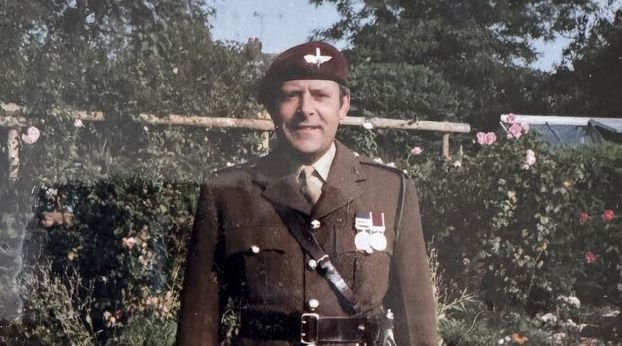


John, one of our Living Well patients, joined the Army when he was 20 and served in the Parachute Regiment for 34 years.
“When I left school, I went to work in the Kent coalfield until I was just over 20 years old,” he said. “One day, I was called into the manager's office, and he said that if I didn't buck my ideas up then not to come back, because I always took Fridays off to meet my future wife, Brenda. I told him to accept my notice right now because I was going to join the Army!”

“I joined the Parachute Regiment and we spent six months in basic training, which included a month parachute training at RAF Abingdon, and a further two weeks training Aldershot before out pass out parade. I was posted to the Defence Platoon in our Brigade Headquarters, and then after a year I was posted to 1st Battalion, where I was sent on a clerical course, after which I was appointed D Company Clerk. In 1962, we were sent to Bahrain for 11 months, then in 1965 we returned there for another 11 months. In 1967, we were sent to Aden, and in 1969 we were posted to Belfast for six months. We returned there three years later, this time with our families. Brenda and I had married in 1959 and had a son, Alistair, who was 12 years old by then. We moved into married quarters and he attended the local school.”
“We were there for 20 months before returning to Aldershot. After that, I spent some time in the Infantry Junior Leaders Battalion in Oswestry, near Shrewsbury, then in a Reserve Unit in London, and then in early 1977 I was promoted to Warrant Officer Class I and posted to Depot Parachute Regiment in Aldershot as the Superintendent Clerk of the Regiment. In 1982, as the 3rd Battalion were preparing to leave for the Falkland Islands, I took over the appointment of Officer Commanding the Rear Party and Welfare Officer to the families of the Battalion. I retired from the army in 1993, after which I worked in a retired officer post with the Aldershot unit of the Royal Military Police.”
John visited our old Hospice when his neighbour was admitted for end of life care.
“My next-door neighbour was there in his last few days, and his wife asked Brenda and I if we'd like to go and see him, so we did. We thought the old Hospice was really good, but the new one has been brought up to date, is spacious, and I think is fantastic!”

John was referred to Phyllis Tuckwell by his GP in early June 2026 and is being cared for by our Living Well team. The team supports patients who need some help living everyday life with their illness. It offers individual appointments and group sessions which tells patients more about their illness and give them advice and support on managing their symptoms.
“I was referred because of all the pains I was having in my thigh, my back, my shoulder, everywhere. At first, I said ‘the Hospice? What's going on?’ But they explained that Phyllis Tuckwell does other things besides end of life care.”
John was visited at home by one of our occupational therapists, who support patients to continue doing the things which are important to them, as independently as possible.
“I've had a couple of people come to see me at home, to see how they could help me. They arranged for a handrail to be put all the way up the stairs, on the other side to the bannister, and for a handle to be put on the bath, and one on the bed to help me pull myself up. They’re all very good and I'm really appreciative. Then they suggested that I might like to go on one of their courses.”

John was invited to join our Living Well with Illness programme, which offers eight weekly group sessions that tell patients more about their illness and how they can manage their symptoms. Each session is led by a member of our specialist team, including physiotherapists, occupational therapists, clinical psychologists and our nursing team, and covers a different topic, such as nutrition, sleep, and exercise. Patients can join our creative programme too, which also consists of eight weekly sessions. Here, patients are invited to take part in a sensory activity such as Mindfulness with Clay, Therapy through Nature or Confidence with Cooking. They can meet others and make friends, engage in activities which they used to enjoy doing, learn new skills, share past experiences, and receive specialist clinical support. Taking part in these creative sessions, where they can make something or share memories which are important to them, boosts their confidence and gives them a sense of achievement.
“I said I wasn’t sure, because I hate going somewhere I don't know anyone. But they suggested that I try it, and if I didn’t like it then I didn’t have to go back. So I went along and I quite enjoyed it! Then I went to the second one and I quite enjoyed that too!”

John started going to sessions at our Beacon Centre in Guildford and then moved to the new Hospice when it opened.
“I feel a lot freer since going there. I was stuck in the house every day. I’ve got two granddaughters, Laura and Rachel, they're Alastair and Claire’s children, and three grandchildren. My family visit me every Friday plus occasions, but sitting here at night, I sometimes feel a bit lonely, and these courses help with that. The social aspect is very good. I get picked up and driven there by one of Phyllis Tuckwell’s volunteer drivers, and I get to know them quite well. They're really very good too. I’m very happy at having been referred.”

