
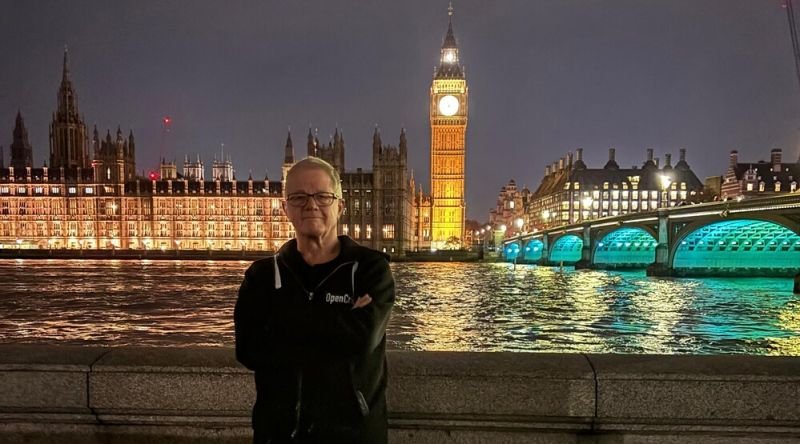


One of our patients, Don, has recently completed the Thames Path Walk, raising over £4,000 to help fund our care.

Caption: Don with his daughter, Lucy.
“I was diagnosed with motor neurone disease (MND) in September 2024 and was referred to Phyllis Tuckwell by my doctor,” he said. “It was then that I realised I had a terminal illness - the penny hadn't dropped before that. I went to the Beacon Centre and saw one of their doctors, Dr Sarah, and we had a good conversation. From there on I've been looked after extremely well by Phyllis Tuckwell. I’ve seen various different people - physiotherapists, occupational therapists, speech therapists, dietitians, counsellors. I've been quite overwhelmed with the support I've been getting. It's incredible.”
“I joined the MND Association in the December after my diagnosis, and they were doing a fundraiser, to run 31 miles in January. I thought, ‘I can do that’, so I signed up and did it, and I raised £3,500. As I'd also just been referred to Phyllis Tuckwell, I really wanted to do some fundraising for them as well, so I began to think about what else I could do. My legs were still strong, so I decided to do a sponsored walk. I chose the Thames Path Walk because it’s local, and my family and friends would be able to join me for parts of it quite easily.”

The Thames Path runs for 185 miles, from its origin in the Cotswolds through to the Thames barrier in Woolwich. Don walked it with his partner, Lynn, and they were joined at many points along it by family and friends. They completed the walk in four stages, walking around 10 miles a day.
“We overdid it in the first few days, so we had to slow down. The heat in August was tremendous; it was in the 30s. Eventually we settled into a pattern, and it took us 26 days in total. At the start, I was joined by my daughter Lucy and her husband Alex, my partner Lynn, and some friends of ours, Joe and Pete. Then it was just me and Lynn for a bit, and then others joined us at various stages later. I play walking football and Dave and Mick, some friends from that, joined us, and later on an old school friend Janet. On the last day, we had about eight people walking with us up to the Thames Barrier including my son Matt. Fundraising is so important for Phyllis Tuckwell. When you consider the services they offer to patients - for free - you can see how fundraising is crucial to the organisation.”

Don has been supported by our Living Well and Hospice at Home teams. Our Living Well team supports patients who need some help managing living everyday life with their illness, and our Hospice Home team visits and supports patients at home.
“I've been helped and guided considerably by Phyllis Tuckwell. Catherine, one of their occupational therapists, visited me at home last week to look at toilet facilities and assistance for me in the kitchen, because it's becoming increasingly difficult for me to do things now. She's been a great help.”
Our occupational therapists provide a range of support, including advice, guidance and equipment, to help patients continue to manage activities that are important to them, such as cooking and personal care, as independently as possible for as long as they can. By meeting with patients regularly, they can work with them as their condition progresses, providing the support they currently require, and looking ahead to prepare for their future needs. Our occupational therapists work closely with our physiotherapists, who offer support such as individual and group exercise sessions, to help patients increase their mobility and muscle strength, and improve symptoms such as breathlessness.
“I've had a few sessions with Sue, one of their physiotherapists, over at the Beacon Centre, which have been tremendous. I really enjoy them. I've been stretched in places I didn't know I could be stretched! It really helped me understand how my condition is changing; it’s been really helpful.”
We care for patients on our In-Patient Unit in Camberley, at the Beacon Centre in Guildford, and in patients’ own homes and care homes across our catchment area of West Surrey and North-East Hampshire. At the Beacon Centre, our Living Well team offers individual and groups sessions to patients and their carers, and runs drop-in coffee afternoons where patients, families and carers can meet and get to know each other. These sessions are also open to anyone who would like to find out more about our services.
“The Beacon Centre feels like home now. I feel welcome there. I know the person on the desk, and the person who helps with the car parking. When I walk through the corridors there, people say ‘oh hello Don, how are you doing?’ I've been along to a few coffee mornings there too, when I’ve been in to see one of the therapists. They invite me along, they just say to come and get involved. It’s really nice. Every time I go there, I meet somebody new.”
The care we provide Don is coordinated by Lyn, our MND clinical specialist. Because of the complexity of MND, a number of healthcare professionals can be involved in a patient’s care, so Lyn acts as a single point of contact between patients and the team who support them.
“The specialist knowledge that Lyn has is incredible and it is really supportive. I have a meeting with her every two months or so, and I can choose to see her more regularly than that, or less regularly. It's entirely up to me. She phones me once a month, and then we meet face to face either at my home or at the Beacon Centre. My family have sat in on some of those sessions with me, which has helped them to learn more about MND. The other thing I've been so impressed with is how connected everybody is. If I talk to one of them about something, they all pass on that information, within the team that’s caring for me. It's really impressive. And that extends outside of Phyllis Tuckwell too, to my GP and the staff at the John Radcliffe University in Oxford, where I was diagnosed and who also look after me. They’re all in contact with each other and it's really quite comforting.”
Lots of different specialists can be involved in a patient’s care, from consultants and specialty doctors, to clinical nurse specialists, physiotherapists, occupational therapists, complementary therapists, our nursing teams, counsellors, patient & family advisors, our Pastoral Care team, and other local healthcare providers such as GPs and district nurses. They meet with each other regularly to discuss the patients we are caring for, sharing their specialist knowledge and deciding how best to support each individual patient and their relatives and carers. This collaborative working is so important in enabling us to provide a joined-up service and give our patients and their loved ones the best care we can. As well as physical support to help him manage his condition, Don has been offered emotional support too.
“I asked for some counselling sessions, and I've been seeing Kate, one of their counsellors, over at the Beacon Centre. It's really helped me to talk through the situation I'm in and how to deal with it and how to tell other people about it. I'm just so grateful to Phyllis Tuckwell for all the help and support they’ve provided me with. It becomes like a family, like a team around me, and I really appreciate that. I was pleased to have raised as much money as I did for them, because I know how important it is. It was fun to do the walk, and to be joined at various stages by so many people, and it was very rewarding. But it was quite comforting to get to the end, because I was getting a bit tired. It's not just the walking, it's travelling to the start point, working out where you’re going to walk to and how to get from that endpoint back home or to a hotel. It's quite a challenge to organise. Reaching Richmond really helped, because that's where the underground stretches out to. From then on, I could catch a train into Waterloo, take the underground out, do some of the walk, and end up by an underground station where I could get back to Waterloo and back home at the end of the day. The Fundraising team were very supportive. They provided me with multiple t-shirts, so Lynn and I, and the others who joined us on the walk, could all wear one. They helped me set up my Just Giving page too, and create a QR code which I could carry with me. Sometimes on the walk, we would meet people who would see our t-shirts and ask what we were fundraising for. Often, after we had told them, they would want to make a donation, so I could show them the QR code and they could donate.”
Our fantastic Fundraising team have lots of ideas and ways in which they can support those who are fundraising for us. Our event fundraisers organise Phyllis Tuckwell-led events which people can sign up to, while our community fundraisers support those who have organised their own fundraising activity, like Don. They can supply branded t-shirts, collecting tins, banners and bunting, and can help fundraisers to set up their own fundraising webpage, where people can sponsor them. Don was contacted by Helena, who is one of our community fundraisers. She sent him Phyllis Tuckwell branded t-shirts and kept in touch with him throughout his fundraising and afterwards.

"They were very helpful and supportive. They would send me messages every now and then saying well done. Every day I would post an update of that day’s walk on Facebook, with some photos. I really enjoyed doing that. I had researched the history of the route too and would include a bit of that in each post. People liked reading that, it was really interesting. To anyone who is thinking of doing some fundraising to support Phyllis Tuckwell, I would say talk to somebody in Phyllis Tuckwell and ask them to put you in touch with the Fundraising team. My first introduction to them was via Lyn, my MND specialist. I mentioned to her that I was thinking of doing the Thames Path Walk and she said she would get one of the Fundraising team to call me, and that's how it started. So just talk to anybody internally and they will put you in touch with the right people to start the ball rolling.”

