
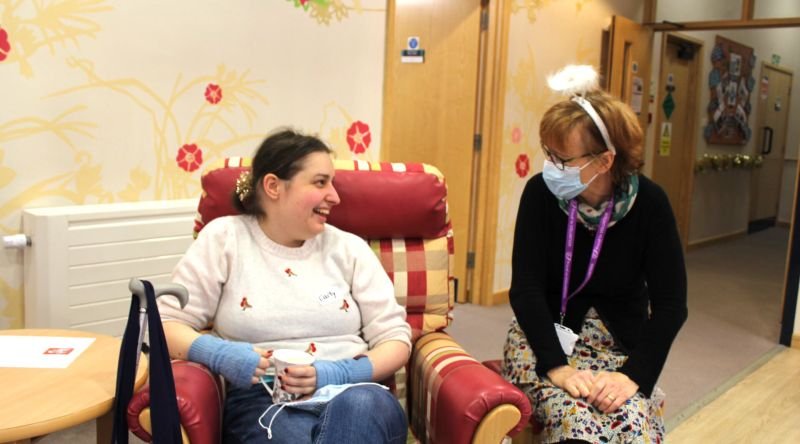


Christina and Keith have supported Phyllis Tuckwell through financial donations since we cared for Keith’s mum on our In-Patient Unit (IPU), over 30 years ago. Since then, we have also cared for their daughter, Carly, and Christina’s mum, both of whom chose to spend their last days at home.
“Mum came in just before Christmas in1992,” said Keith. “She had about two or three days in the Hospice and then she passed away. So that's when we started supporting Phyllis Tuckwell, and we've donated monthly ever since. Then, after Carly was in their care, we started supporting them in other ways, too.”
“Carly was referred to Phyllis Tuckwell about four or five years before she passed away,” said Christina. “Because she'd had lots of treatment, she had lots of side effects. She couldn't really get out and about and do very much. By referring her to Phyllis Tuckwell, she was able to get more support and take part in activities. She could come to the Living Well sessions and do things; be with other people and have an outlet, rather than being stuck at home all the time. It made a big difference.”

As well as caring for patients on our IPU, we also support them earlier in their illness, through our Living Well service. This support includes individual and group sessions where patients can learn more about their illness, manage their symptoms, meet others, and enjoy activities such as Therapy through Nature, Cooking with Confidence, or our volunteer-led Artscape group. Taking part in these sessions can enable patients to continue with a much-loved hobby such as painting or gardening, or learn new skills and gain confidence in their abilities. It also offers them a safe environment where they can chat to our nurses and therapists, get advice on matters such as sleep, exercise and nutrition, and meet and make friends with others.
“Carly came to the sessions every Monday until the Monday before she died,” said Christina. “She was determined to, because she loved it so much. It was very important to her, and it gave us some time as well. It meant that I could relax a bit for a little while, while she was being cared for there.”
“At home, she couldn't do the things that she was really interested in,” said Keith. “She liked painting, and she used to make these little model buildings or rooms in a Japanese style. She really liked the Japanese anime, books and films. But it got to the point where the houses were too fiddly for her. She used to do cross-stitch too - I taught her how to do that - but towards the end she couldn't do it, because her hands were shaking too much and she couldn't hold the needle, or a paintbrush or anything.”
“She joined the Living Well art group,” said Christina, “and she discovered that she could still do a little bit of drawing. The volunteer who ran it was very good at helping her to explore what she could still do, and that made her happy. She did the cooking session, she planted plants, just those small things that she was still capable of using her hands for. It was nice to see her to come back and have things to tell us about, and to bring things back and be pleased. We could see that she felt she was achieving something. Eventually it got to the point where she couldn't really do a lot, but she still loved to be out with other people, just to be part of something different that was going on. And the therapy dog used to come and visit; she loved the therapy dog. We had a dog of our own, she was Carly’s dog really, but sadly we lost her three months before Carly. Carly was missing her, so it was lovely for her to see the therapy dog at the Hospice.”

Our Artscape group offers patients the opportunity to explore different media such as pencil drawing, watercolours, collage and pastels, and use them to express feelings related to their illness, which may be hard to put into words. We also arrange regular visits from Pets as Therapy, whose volunteers bring their dogs to our Hospice and Beacon Centre to see our patients. They love the attention they get, and our patients benefit so much from stroking and petting them. Their visits often spark conversations about patients’ own pets, and can be particularly special for those whose pet is no longer with them.
As well as caring for patients’ medical and physical needs, we also offer emotional and spiritual support. Sometimes, it can be easier to talk to someone who is not a family member or close friend, and our chaplains, counsellors and members of our Pastoral Care team are available if our patients would like to talk to them.
“Carly didn't want to talk to us about dying, or about funeral arrangements, or anything like that,” said Christina, “but she was able to talk to someone when she was at the Hospice, and say things that maybe she felt she couldn't say to us, so it was very helpful from that point of view. She really struggled with the thought of dying, because she just didn't want to. She never gave up.”
Carly was admitted to our IPU for a short time, so our doctors could put in place medication to help her with her severe tremors. She was then discharged and went home, where Christina and Keith continued to care for her, supported by our Hospice at Home team.
As well as caring for our patients, we also support their families too, during their loved ones’ illness and in bereavement. Keith attended one of our carers’ pamper days, where he had a haircut, massage and – on Carly’s request - had his nails painted. Both he and Christina also received counselling.

“I don't think I could have coped without the counselling,” said Keith. “The care from Phyllis Tuckwell has been brilliant. I know it's hard for anybody that's bereaved, but I think it's harder for the parents of a child. You just don't expect to go through it. I've tried to be more supportive for Christina, because she's been through it twice in quick succession, with Carly and with her mum as well now. I've tried to be someone she can lean on, with the help of Phyllis Tuckwell. If I hadn't had the counselling from them, I don’t think I could have done that.”
“Mum had heart failure,” said Christina. “She was cared for by the Hospice at Home team for the last two weeks of her life. I didn't even realise she had a condition that was covered by Phyllis Tuckwell, I thought they just cared for people with cancer. I was having my counselling and the counsellor said to me that Phyllis Tuckwell could support us with Mum as well. It was very important to Mum that she was able to stay at home. She was so glad that I said ‘yes, you can stay with me, you don't have to go into hospital, you can stay at home’. I promised her that, and because of Phyllis Tuckwell I was able to do it. Without them, I couldn't have coped with those last two weeks. Mum would have had to have gone somewhere else, and then that would have been a promise broken. But I carried on looking after her. In her last two weeks my sister, who lives in Australia, came over, and as soon as she arrived Mum was fine for two days, and she took to her bed and that was it really. Those two weeks were awful; we couldn't have done it without Phyllis Tuckwell. They were fantastic, they made sure she was peaceful and well looked after.”
People often think that we only care for older patients, or those with a cancer diagnosis, but we are here for anyone over the age of 18 with an advanced or terminal illness, which includes cancer, but could also be a lung, heart or neurological condition, for example. Many of our patients don’t want to go to hospital or the Hospice, but prefer to remain at home, and so are cared for by our Hospice at Home team, in partnership with their GP and community nurses. Our Hospice at Home team comprises doctors, nurses, health care assistants, physiotherapists, occupational therapists, complementary therapists and counsellors, who can visit patients throughout their illness and in their last days, ensuring that they can stay in the place where they feel most comfortable – at home.
“I can't speak highly enough of hospices,” said Christina. “Phyllis Tuckwell has been my lifeline.”
.jpg)
“Without them, we'd have gone to pieces,” said Keith. “It's nice to know that there is always someone there, even you’ve only got a simple question. And now the new Hospice is finished, it's only going to get better. You've got more space, you've got more facilities now. It's amazing.”
“We became legacy pledgers a long time ago,” said Christina. “When we did our Wills, probably about 15 years ago, our solicitor ran through everything, and she asked if we wanted to leave anything to a charity, and we said yes, we’d like to leave some money to Phyllis Tuckwell.”
Christina and Keith have very kindly decided to leave a gift in their Will to Phyllis Tuckwell. Gifts in Wills are really important in helping fund our future care. Knowing that we will have that money in the future enables us to plan ahead, develop our services, and care for more people who will need our specialist care in years to come.
“We were very happy to; it’s very important,” said Keith. “We've tried to do as much as we can. If everybody was to do a little, it would make a big difference, because places like this are just so important. We want people to feel that they've got this and that it can help them the way it's helped us.”
"It just means leaving a nicer future for other people,” said Christina.

