
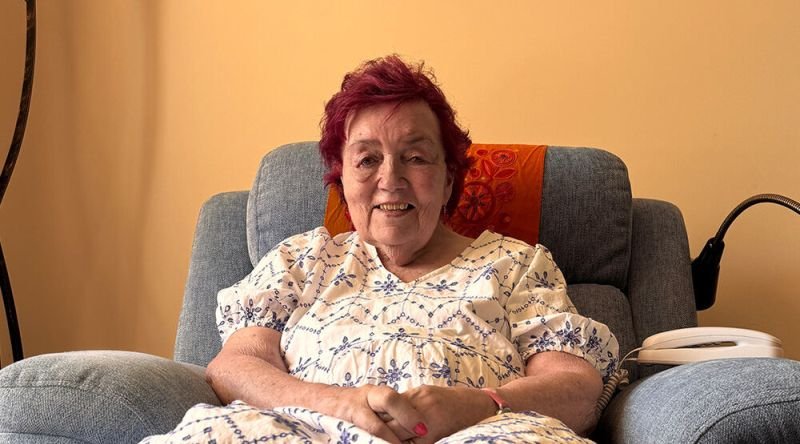


Cathy’s husband John was referred to Phyllis Tuckwell in 2016, and in 2019 he spent his last days on our In-Patient Unit (IPU), where we cared for him and supported Cathy, too.

“I was aware of Phyllis Tuckwell, but I never thought I would need its services,” said Cathy. “Then my lovely husband John, who was 10 years younger than me, was diagnosed with terminal cancer. He was only 58. It was already stage four, and so he was referred to Phyllis Tuckwell.”
John and Cathy were told about our Living Well service, which supports patients earlier in their illness, helping them to continue living life as fully and independently as possible, for as long as they can. The team also supports patients’ loved ones too, through carer sessions and counselling.
“We were told us about the services that Phyllis Tuckwell provides, both at the Hospice and at the Beacon Centre in Guildford. At that time, John didn't feel that he needed them, but I accepted the offer of counselling, and I found it really helpful. John’s medical team encouraged him to visit the Hospice, so he and I could see what it was like there, so the two of us went along one afternoon. We were really impressed. It was lovely; there was really a nice atmosphere there. We saw all the facilities and looked around the garden, and as we drove away I asked John what he thought of it. He said it was completely different to what he had been expecting. He’d thought it would be like a hospital, but it wasn’t.”
Our 18-bed IPU provides a peaceful environment for our patients. It is light and spacious, with ensuite facilities in each room, and gardens which patients’ beds can be wheeled out into if they would like. Relatives and friends can visit at any time, and there are facilities for loved ones to stay by the patient’s bedside overnight if they wish.
“By that point, the cancer had spread, but John still fought hard. He did the 100 miles around London cycle ride, raising funds for both for Phyllis Tuckwell and a prostate cancer charity. He did that four times, and then he did another one around Birmingham. He just kept going! He was a keen remote-control sailor on the local lakes, and he did that. He also built himself a kit car. I’ve got a photo on a cushion, of him when he'd finished it completely, but before it was legal to drive on the road. All he could do was back it out of the garage, but the grin on his face speaks volumes. He was so pleased and proud of himself. It was therapy for him, all these things.”

“But then the pain started to become a big issue. He decided to start counselling sessions. We didn’t discuss them, but he said he found them very helpful. I think he was really struggling by then and didn't want me to realise how bad it had got for him. He started to find self-care very difficult. I was having to help him up and down the stairs; it really was becoming very hard. Mentally I was able to cope, but physically I couldn’t.”
Cathy was still caring for John at home, but she knew they both needed more support.
“It was a Thursday when it really started to go downhill. He wasn’t with it; he couldn’t understand what I was saying to him. By Saturday night, I couldn't get him upstairs to bed. He said he would sleep downstairs in the recliner chair, but the trouble was he couldn't get out of the chair to go to the bathroom. I told him I thought we needed to ring somebody, but he didn’t want me to, he didn’t want to go into hospital. He was adamant. He got upset and agitated. A friend of mine came over and we called 111, and they sent an ambulance, but he wouldn't go with them to the hospital, so they advised me to call Phyllis Tuckwell in the morning. The next day was a Sunday though, and I thought there's not going to be anyone to call. But I rang them at 8am, and by 8.30am there was somebody with us at the house. She was a nurse, and she'd been visiting another patient nearby, so she was in the area. She assessed John and said that the best thing would be to get him admitted to the IPU, but there wasn’t a bed free. She started to organise a hospital bed for us to have at home instead, and while she was on the phone, a bed at the Hospice became available. By midday he was there. He asked me where he was, and I told him he was in the Hospice. He just said, ‘ah fantastic’, and the relief on his face, it was like a weight had been lifted off his shoulders. He was so happy to be there, and I was happy for him to feel like that."
Our rapid response community team aims to see people with the most urgent needs within 24hrs, and provides support over the phone prior to that. In some cases, such as John's, we are able to visit sooner. Patients often want to remain at home and receive care there, but those who do need to be admitted to our IPU may have to wait a few days for a bed to become available. We always strive to visit and admit people as soon as possible, and we were very pleased to have been able to respond to John's needs so quickly.
“I spent all day there with him, and on the Monday too, and by the Tuesday I knew I needed to spend all night there as well. He died that night at 11pm. I was glad that he was in the Hospice, and that I was there with him. It was really important. I didn't want to miss what was happening for him. I could see that he was slipping away and I wanted to share that with him; I didn't want him to be alone, going away. He was in his own room, I was talking to him and holding his hand, it’s a happy memory.”
“I don't know what that experience would have been like without Phyllis Tuckwell to take so much of the burden from me. There’s more to caring than just the physical side of it, and that's what Phyllis Tuckwell offers. They genuinely cared about my husband and about me. It was good that I could just hand it to somebody who would help me to cope with it. That’s what I got from being there.”
After John died, we continued to support Cathy through bereavement counselling.
“They were very good; they did so much for me. That’s why I want to give them something back and encourage others to do the same. I talk to people about Phyllis Tuckwell and about John's experience with them. I have a monthly direct debit, and when I was downsizing my house, I donated a lot of my things to their Retail Centre in Farnborough, all sorts of really nice things. And I thought, maybe leaving a legacy is something else that I can do to help them. To have that support, that you can't get anywhere else, to be able to help provide it, is what a legacy would do. It would mean so much to even just one person who was going through such a terrible experience. And for the person leaving the legacy, it gives you a fulfilled feeling, that something you’ve done is going to help someone. It’s a good thing to do.”

